Learn Arabic Online — 1:1 Classes for Non-Native Speakers
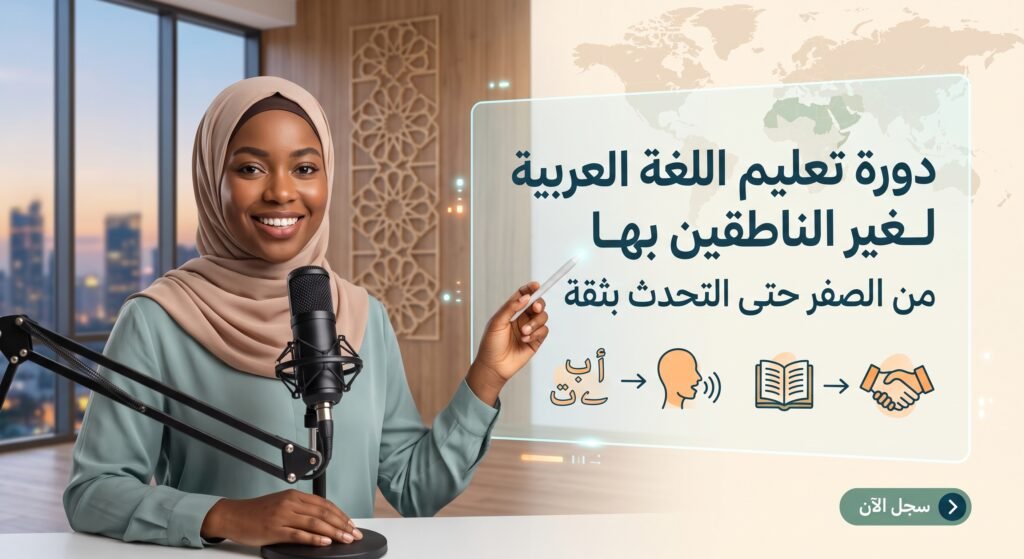
Many Muslims recite the Quran but wish they understood it. Others grew up abroad and lost the Arabic of their parents. If you want to learn Arabic online with real progress rather than another app streak, our one-to-one classes are built for non-native speakers and heritage learners, with a certified teacher who adapts every lesson to you.
Our teachers explain everything in English (or French or German), so you do not need to speak Arabic to start.
What you learn
- Reading and writing the Arabic script.
- Essential vocabulary and everyday conversation.
- Grammar explained simply and practised straight away.
- Reading comprehension, working towards understanding Quranic and classical texts.
Your Arabic course in four stages
- Script and sounds: the letters in their different forms, short and long vowels, and the sounds that do not exist in English.
- Foundations: common words, numbers, simple sentences and questions about daily life.
- Grammar in use: the nominal and verbal sentence, pronouns, the past and present tense, and how word roots build families of related words.
- Reading for meaning: short texts, frequent Quranic vocabulary, and verses you recite in prayer, read with understanding.
You do not have to start at stage one. In the trial lessons, your teacher checks what you already know and places you where the work will be useful.
Who it is for
Complete beginners, learners with some basics, children of Arabic-speaking families living abroad, and new Muslims who want to understand their prayers and the Quran.
A private Arabic lesson, step by step
A typical class opens with a quick review of last lesson’s words. Your teacher then introduces one new point, for example a verb pattern or a set of everyday expressions, and you use it at once in speaking, reading or writing. The lesson ends with a short task for the days in between, such as copying a few lines, learning a word list or reading a paragraph aloud. Because there is only one student, the teacher can slow down, repeat or move ahead whenever you need.
Arabic course or Quran reading class?
| Arabic for non-native speakers | Quran reading and Tajweed | |
|---|---|---|
| Main goal | Understand and use the language | Recite the Quran correctly |
| Focus | Vocabulary, grammar, comprehension, conversation | Pronunciation, rules of recitation, fluency |
| Good next step after | Reading the letters | The Noorani Qaida |
Many students combine both: they continue Tajweed to recite well while building Arabic to understand what they recite.
Heritage learners and families abroad
Children who hear Arabic at home but answer in English often understand more than they can say. Their lessons focus on speaking with confidence, reading and writing, so that they can talk with grandparents and follow Arabic texts. Adults who studied as children can rebuild what faded without repeating the basics they already know.
How progress is tracked
Your teacher notes the vocabulary and grammar you have covered and returns to weak points regularly. You will notice progress in concrete ways: reading a sentence without help, writing a short paragraph, or recognizing words in the Quran you recite.
Price
Arabic classes start from $50 per month for two 30-minute lessons a week; the price increases with more hours. See all prices.
Learning Arabic online: frequently asked questions
I am a complete beginner. Is that fine?
Yes. The course starts from the letters and moves at your pace.
Are the lessons private?
Yes, every lesson is one-to-one and live with your teacher.
Do you teach Modern Standard Arabic or a dialect?
The course teaches standard Arabic (Fusha), the language of the Quran and of written Arabic, which is what you need to understand Quranic texts.
Will learning Arabic help me understand the Quran?
Yes, gradually. Later stages focus on Quranic vocabulary and on reading verses you already recite with their meaning.
Can my children take Arabic lessons too?
Yes. Children have their own one-to-one lessons, adapted to their age and to how much Arabic they already hear at home.