Rules of Noon Sakinah and Tanween: A Complete Tajweed Guide
When you begin learning Tajweed (the rules governing the pronunciation of the Quran), the first chapter you usually encounter is the rules of Noon Sakinah and Tanween. This is because these rules appear on almost every page of the Mushaf (the written copy of the Quran). Mastering these rules significantly improves your recitation, ensuring that the Ghunnah (nasal sound) appears exactly where it belongs. In this article, we explain the four rules according to the narration of Hafs ‘an ‘Asim, providing examples from the Quran, tips on recognizing them through Quranic script marks, and a practical exercise for you to apply.
Defining Noon Sakinah and Tanween
Noon Sakinah is a Noon that has no vowel (Haraka) on it. It can appear in the middle or at the end of a word, and it is found in nouns, verbs, and particles. Examples include: ﴿يَنْهَوْنَ﴾ (Yan-hawna), ﴿مِنْ﴾ (Min), and ﴿أَنْعَمْتَ﴾ (An’amta).
Tanween is a “double vowel” at the end of a noun that is pronounced as a Noon Sakinah but not written as one. It appears as Fathatayn, Dammatayn, or Kasratayn (double accents). Examples include: ﴿عَلِيمًا﴾ (Aleeman), ﴿غَفُورٌ﴾ (Ghafoorun), and ﴿رَحِيمٍ﴾ (Raheemin).
Because Tanween sounds exactly like a Noon Sakinah when spoken, it follows the same Tajweed rules. The specific rule is determined by the letter that immediately follows the Noon or Tanween. This is your key: always look at the following letter.
Izhar Halqi: Clear Noon Without Extra Ghunnah
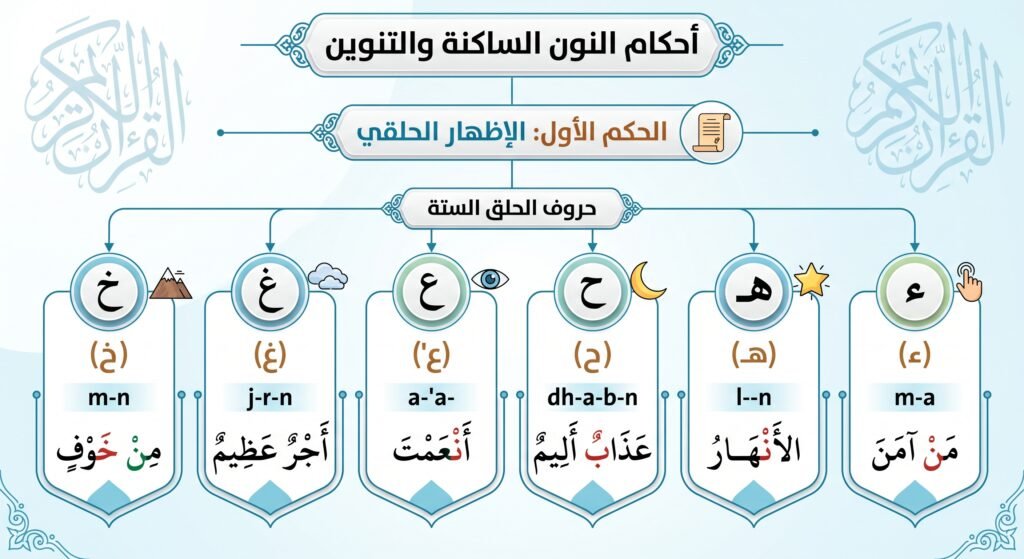
If one of the six throat letters (Huroof al-Halq) follows a Noon Sakinah or Tanween, you must apply Izhar. This means pronouncing the Noon clearly from its point of articulation (Makhraj) without any extra nasalization (Ghunnah).
The throat letters are: Hamzah (ء), Haa (هـ), ‘Ayn (ع), Haa (ح), Ghayn (غ), and Khaa (خ). Scholars often memorize them through the first letters of the Arabic phrase: “Akhi Haaka ‘Ilman Haazahu Ghayru Khaasir.”
Examples include:
- Hamzah: ﴿مَنْ آمَنَ﴾ (Man aamana)
- Haa (هـ): ﴿مِنْهُمْ﴾ (Minhum)
- ‘Ayn: ﴿مَنْ عَمِلَ﴾ (Man ‘amila)
- Haa (ح): ﴿عَلِيمٌ حَكِيمٌ﴾ (‘Aleemun Hakeem)
- Ghayn: ﴿مِنْ غِلٍّ﴾ (Min ghillin)
- Khaa: ﴿مِنْ خَيْرٍ﴾ (Min khayrin)
The reason for Izhar is the distance between the exit point of the Noon (the tip of the tongue) and the exit points of the throat letters, which prevents them from being merged or hidden.
Idgham: The “Yarmaloon” Letters and Its Types
Idgham means merging the Noon Sakinah or Tanween into the following letter so they become a single emphasized (mushaddad) letter. There are six letters of Idgham, grouped in the word “Yarmaloon” (يرملون). Note that Idgham only occurs between two separate words.
Idgham with Ghunnah (Nasalization)
This occurs with four letters grouped in the word “Yanmu” (ينمو): Yaa, Noon, Meem, and Waw. In this case, the merging is accompanied by a nasal sound lasting for two beats. Examples: ﴿مَن يَقُولُ﴾ (May-yaqool), ﴿مِن نِّعْمَةٍ﴾ (Min-ni’mah), ﴿مِن مَّاءٍ﴾ (Mim-ma’), ﴿مِن وَالٍ﴾ (Miw-waal).
Idgham without Ghunnah
This occurs with the letters Laam (ل) and Raa (ر). The Noon is merged completely into the following letter with no nasal sound at all. Examples: ﴿هُدًى لِّلْمُتَّقِينَ﴾ (Hudal-lilmuttaqeen), ﴿مِن رَّبِّهِمْ﴾ (Mir-rabbihim).
Important Exceptions
- If a Noon Sakinah is followed by Yaa or Waw within the same word, you do not merge them. Instead, you must pronounce the Noon clearly. This is called Izhar Mutlaq (Absolute Clarity), and it occurs in only four words in the Quran: ﴿الدُّنْيَا﴾ (Ad-Dunya), ﴿بُنْيَانٌ﴾ (Bunyan), ﴿قِنْوَانٌ﴾ (Qinwan), and ﴿صِنْوَانٌ﴾ (Sinwan).
- In the narration of Hafs, there is a slight pause (Sakt) on the Noon in Surah Al-Qiyamah, verse 27: ﴿مَنْ ۜ رَاقٍ﴾ (Man… Raq). Because of this pause, Idgham is not applied.
Iqlab: When Noon Turns into Meem
Iqlab has only one letter: Baa (ب). If a Baa follows a Noon Sakinah or Tanween, the Noon sound is converted into a hidden Meem accompanied by a two-beat Ghunnah.
Examples: ﴿مِنۢ بَعْدِ﴾ (Mim-ba’di), ﴿أَنۢبِئْهُم﴾ (Ambi’hum), ﴿سَمِيعٌۢ بَصِيرٌ﴾ (Samee’um-baseer).
How to pronounce it: Pronounce a Meem instead of the Noon with a clear nasal sound, then transition to the Baa. There are two common ways scholars teach the position of the lips during Iqlab: closing them very lightly or leaving a tiny gap. The key is not to press the lips together forcefully. Follow what your qualified teacher demonstrates.
Ikhfa: The Middle Ground Between Izhar and Idgham
Ikhfa involves pronouncing the Noon in a state between Izhar and Idgham, without Shaddah (emphasis), while maintaining a two-beat Ghunnah. There are fifteen letters of Ikhfa—essentially all the letters remaining after excluding the letters of Izhar, Idgham, and Iqlab.
Examples include: ﴿أَنفُسَكُمْ﴾ (Anfusakum), ﴿مِن قَبْلِ﴾ (Min qabli), ﴿عَنكُمْ﴾ (‘Ankum), ﴿مَنصُورًا﴾ (Mansoora), ﴿رِيحًا صَرْصَرًا﴾ (Reehan sarsara), ﴿مِن ذَكَرٍ﴾ (Min zakarin).
Important Note: The Ghunnah in Ikhfa follows the letter that comes after it in terms of heaviness (Tafkheem) or lightness (Tarqeeq). The nasal sound is heavy before “heavy” letters like Qaaf, Saad, and Ta, and light before others. Common mistakes include holding the Ghunnah for too long or touching the tip of the tongue to the roof of the mouth, which makes the Noon sound too clear.
Review Table and Practical Training
| Rule | Letters | Ghunnah | Mushaf Mark (Medina Script) |
|---|---|---|---|
| Izhar | ء هـ ع ح غ خ | No extra length | Sukun (small ḥaa) on the Noon; perfectly aligned Tanween |
| Idgham w/ Ghunnah | ي ن م و | 2 Beats | Noon with no Sukun; offset/sequential Tanween |
| Idgham w/o Ghunnah | ل ر | None | Noon with no Sukun; Shaddah on the next letter |
| Iqlab | ب | 2 Beats | A small Meem (م) above the Noon or Tanween |
| Ikhfa | 15 letters | 2 Beats | Noon with no Sukun; offset Tanween; no Shaddah on next letter |
Exercise: Identify the Rule
Read the following verses and identify the rule for each Noon Sakinah or Tanween, then check your answers below:
- ﴿وَيْلٌ لِّكُلِّ هُمَزَةٍ لُّمَزَةٍ﴾ [Al-Humazah: 1] — Answer: “Waylun-li” and “Humazatin-lu” are both Idgham without Ghunnah.
- ﴿فِي عَمَدٍ مُّمَدَّدَةٍ﴾ [Al-Humazah: 9] — Answer: “Amadim-mumaddadah” is Idgham with Ghunnah.
- ﴿مِن شَرِّ مَا خَلَقَ﴾ [Al-Falaq: 2] — Answer: “Min sharri” is Ikhfa.
- ﴿لَيُنۢبَذَنَّ فِي الْحُطَمَةِ﴾ [Al-Humazah: 4] — Answer: “Layumbazanna” is Iqlab.
Repeat this exercise with a short Surah every day, and you will find that recognizing these rules becomes second nature.
Frequently Asked Questions
How many rules are there for Noon Sakinah and Tanween?
There are four main rules: Izhar, Idgham, Iqlab, and Ikhfa. Idgham is further divided into Idgham with Ghunnah and Idgham without Ghunnah.
What is the difference between Noon Sakinah and Tanween?
Noon Sakinah is written and pronounced regardless of whether you stop or continue. Tanween is only pronounced as a Noon sound when continuing recitation; it is not written as a letter “Noon” and usually disappears when stopping at the word.
Why don’t we apply Idgham in the word ‘Ad-Dunya’ despite the Yaa following a Noon?
Because Idgham only happens between two words. If they appear in the same word, we apply “Izhar Mutlaq” (Absolute Clarity) to preserve the meaning and structure of the word.
How long should the Ghunnah be in Ikhfa?
It should be held for two beats. You should avoid making it too short or dragging it out excessively.
Can I master these rules without a teacher?
While you can learn the theory from books and articles, the precise pronunciation of the Ghunnah and Ikhfa requires listening to and being corrected by a qualified teacher. The difference between correct and incorrect pronunciation can be very subtle.
Mastering the rules of Noon Sakinah and Tanween is your gateway to accurate Quranic recitation. Review them through daily practice rather than just theoretical memorization. To explore more terms, browse our Tajweed Glossary. Then, book a free trial lesson at Quran Web Academy. If the teacher isn’t a perfect fit, you can have a second trial with another qualified teacher to help perfect your pronunciation.