Difference Between Quran and Mus’haf: A Comprehensive Guide

Many of us use the words “Quran” and “Mus’haf” as if they are the same. We might say, “I am holding the Quran,” when we actually mean the printed book. While this is common and acceptable in daily conversation, understanding the precise difference between the Quran and the Mus’haf helps you better understand scholarly discussions and specific Islamic rulings (Fiqh). In this article, we will explain both terms clearly and introduce other essential terminology every learner needs.
Scholarly Definition of the Quran
Linguistically, the word “Quran” comes from the root qara’a, meaning to read or collect. Technically, scholars define the Quran as: The Word of Allah, revealed to His Prophet Muhammad (peace be upon him), whose recitation is an act of worship, transmitted to us via Tawatur (mass transmission), beginning with Surah Al-Fatiha and ending with Surah An-Nas.
Each part of this definition has a specific purpose:
- The Word of Allah: This excludes the speech of humans and angels.
- Revealed to Muhammad (peace be upon him): This excludes previous scriptures like the Torah (Tawrat) and Gospel (Injeel).
- Recitation is an act of worship: This means that simply reciting it earns the Muslim rewards and it is read during Salah (prayer). This distinguishes it from Hadith Qudsi.
- Transmitted via Tawatur: It was passed down by such a large number of people in every generation that it is impossible for them to have conspired on a mistake. This excludes irregular recitations (Shadhdh).
Allah Himself has guaranteed its preservation, saying: إِنَّا نَحْنُ نَزَّلْنَا الذِّكْرَ وَإِنَّا لَهُ لَحَافِظُونَ (“Indeed, it is We who sent down the message [i.e., the Quran], and indeed, We will be its guardian.”) (Al-Hijr: 9).
Meaning of Mus’haf and Its Compilation
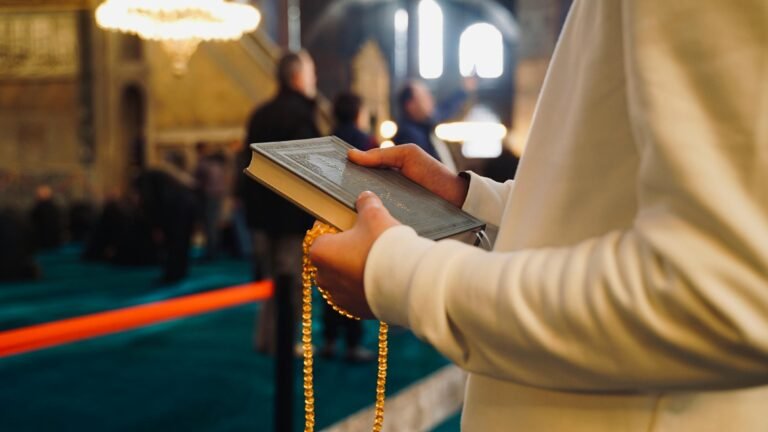
Linguistically, Mus’haf refers to a collection of pages (Suhuf) bound between two covers. Technically, it is the physical book in which the Holy Quran is written in its well-known order.
The compilation of the Quran went through several stages. During the time of the Prophet (peace be upon him), the Quran was preserved in the memories of the Sahaba (companions) and written on various materials like parchment, bones, and palm branches. During the caliphate of Abu Bakr Al-Siddiq (may Allah be pleased with him), it was collected into a single set of pages after many reciters (Qurra’) were martyred in the Battle of Yamama. Later, during the caliphate of Uthman ibn Affan (may Allah be pleased with him), standardized copies were made and sent to different regions to unite the Ummah on a single script.
This led to the term Uthmanic Script (Al-Rasm al-Uthmani). This is the specific way words are spelled in the Mus’hafs copied during Uthman’s time. It features unique characteristics in how certain letters are added or omitted, which differs from standard modern Arabic spelling—for example, the way “As-Salah” or “Ar-Rahman” is written in the Mus’haf.
Quran vs. Mus’haf: Key Differences at a Glance
| Point of Comparison | The Quran | The Mus’haf |
|---|---|---|
| Nature | The revealed Word of Allah. | The paper and ink containing those words. |
| Existence | Preserved in hearts, recited by tongues, and written in lines. | A physical written or printed copy. |
| Quantity | There is only one Quran. | There are millions of physical Mus’hafs in various prints. | Can be recited from memory without needing to touch anything. | Specific rulings apply to touching or carrying it. |
When a Hafiz (someone who has memorized the Quran) recites from memory, they are reciting the Quran without holding a Mus’haf. Similarly, even if a Mus’haf is printed in different fonts or sizes, the Quran contained within it remains one and unchanged.
Related Terms: Wahy, Tanzil, Ayah, and Surah
Wahy (Revelation)
This is the process by which Allah informs His Prophets of what He wants them to convey. This can happen through direct speech behind a veil, through an angel, or through true dreams. The entire Quran was revealed through the Angel Jibreel (Gabriel), peace be upon him.
Tanzil (Sending Down)
Scholars mention that the Quran was sent down as a whole to the lowest heaven on Laylat al-Qadr (The Night of Decree). Afterward, it was revealed gradually to the Prophet (peace be upon him) over 23 years according to events. Allah says: إِنَّا أَنزَلْنَاهُ فِي لَيْلَةِ الْقَدْرِ (“Indeed, We sent it [the Quran] down during the Night of Decree.”) (Al-Qadr: 1).
Ayah (Verse)
An Ayah is a sentence or segment of the Quran with a defined beginning and end, contained within a Surah. According to the Kufic counting system followed by most Mus’hafs printed in the Hafs ‘an ‘Asim narration, there are 6,236 verses. Other counting systems exist, but they only differ in where a verse ends, not in the actual content of the Quran.
Surah (Chapter)
A Surah is a collection of verses with a beginning, an end, and a specific name. There are 114 Surahs in the Quran; the longest is Al-Baqarah and the shortest is Al-Kawthar. They are classified as Makki (revealed before the Hijrah) or Madani (revealed after the Hijrah).
Divisions of the Mus’haf: Juz, Hizb, and Ruba’
These divisions were created by scholars to make reading, Hifz (memorization), and revision easier; they are not part of the original revelation:
- Juz (Part): The Mus’haf is divided into 30 Juz of roughly equal length, making it easy to complete the Quran in one month.
- Hizb (Group): Each Juz is divided into two Hizbs, totaling 60 Hizbs in the entire Quran.
- Ruba’ (Quarter): Each Hizb is divided into four quarters, totaling 240 quarters.
Knowing these divisions helps you organize your study. For example, you might say, “I will memorize one Ruba’ per week and revise one Hizb every day.” Teachers at Quran Web Academy use these divisions to create structured plans for students.
There is also the division by pages. The famous Madinah Mus’haf consists of approximately 604 pages, and many students of Hifz measure their progress by the number of pages (often called “Wajh” or face of a page) they have mastered.
Etiquette (Adab) of Handling the Mus’haf
Because the Mus’haf contains the Word of Allah, Muslims treat it with the utmost respect. Agreed-upon etiquettes include:
- Placing it in a high, clean place and never putting anything on top of it.
- Striving to be in a state of Wudu when touching it, following the majority scholarly opinion.
- Never leaving it neglected or exposing it to disrespect.
- Disposing of damaged pages in a dignified manner, such as burial in a clean place, as advised by scholars.
- Reading it with Tadabbur (reflection) and Tajweed (proper pronunciation), rather than just keeping it for decoration.
The greatest form of honoring the Quran is to act upon its teachings and learn to recite it correctly, as Allah said: وَرَتِّلِ الْقُرْآنَ تَرْتِيلًا (“…and recite the Quran with measured recitation.”) (Al-Muzzammil: 4).
Frequently Asked Questions
Is it okay to say “the Quran” when I mean the physical book?
Yes, this is common and understood in daily speech. However, in legal (Fiqh) contexts, the distinction is made because certain rulings apply specifically to the physical book (the Mus’haf).
What is the difference between the Quran and Hadith Qudsi?
The Quran’s wording and meaning are both from Allah; its recitation is an act of worship, it is miraculous (I’jaz), and it is transmitted via Tawatur. A Hadith Qudsi is a message from Allah narrated by the Prophet (peace be upon him) in his own words; it is not recited in Salah and does not carry the specific legal rulings of the Quran.
How many Surahs and Ayahs are in the Quran?
There are 114 Surahs. There are 6,236 Ayahs according to the Kufic count. Slight variations in other counting systems relate only to where a verse is marked to stop, not the text itself.
Can I touch the Mus’haf without Wudu?
The majority of scholars hold that it should only be touched by someone in a state of purity. However, reciting the Quran from memory without touching the Mus’haf is perfectly permissible for someone in a state of minor ritual impurity.
What is meant by the Uthmanic Script (Rasm al-Uthmani)?
It refers to the specific orthography and spelling used in the copies of the Quran compiled during the time of the third Caliph, Uthman (may Allah be pleased with him). Modern printed Mus’hafs strictly adhere to this script.
Understanding these terms is the first step. The most important next step is to learn to recite the Quran correctly as it was revealed. Start by reviewing our guide on Tajweed rules and terms. Then, book a free trial lesson with Quran Web Academy. If you aren’t a perfect match with your first teacher, you can try a second free lesson with another qualified, Ijazah-certified teacher in a private, one-on-one session.